
What Happens When You Sell Your Name? The Jo Malone Trademark Case Explained
Authored by Maddie Dugan, CIPM and Michele Martell, Esq.
In March 2026, Estée Lauder filed a lawsuit in the UK High Court against Jo Malone, along with her current fragrance company Jo Loves and Zara's UK business. The claim centers on packaging for a Zara fragrance collection that reads: "A creation by Jo Malone CBE, founder of Jo Loves.”
The case is getting attention because of who's involved. But the legal questions it raises are ones that any founder selling a business, or any brand entering a licensing collaboration, should understand before they sign anything.
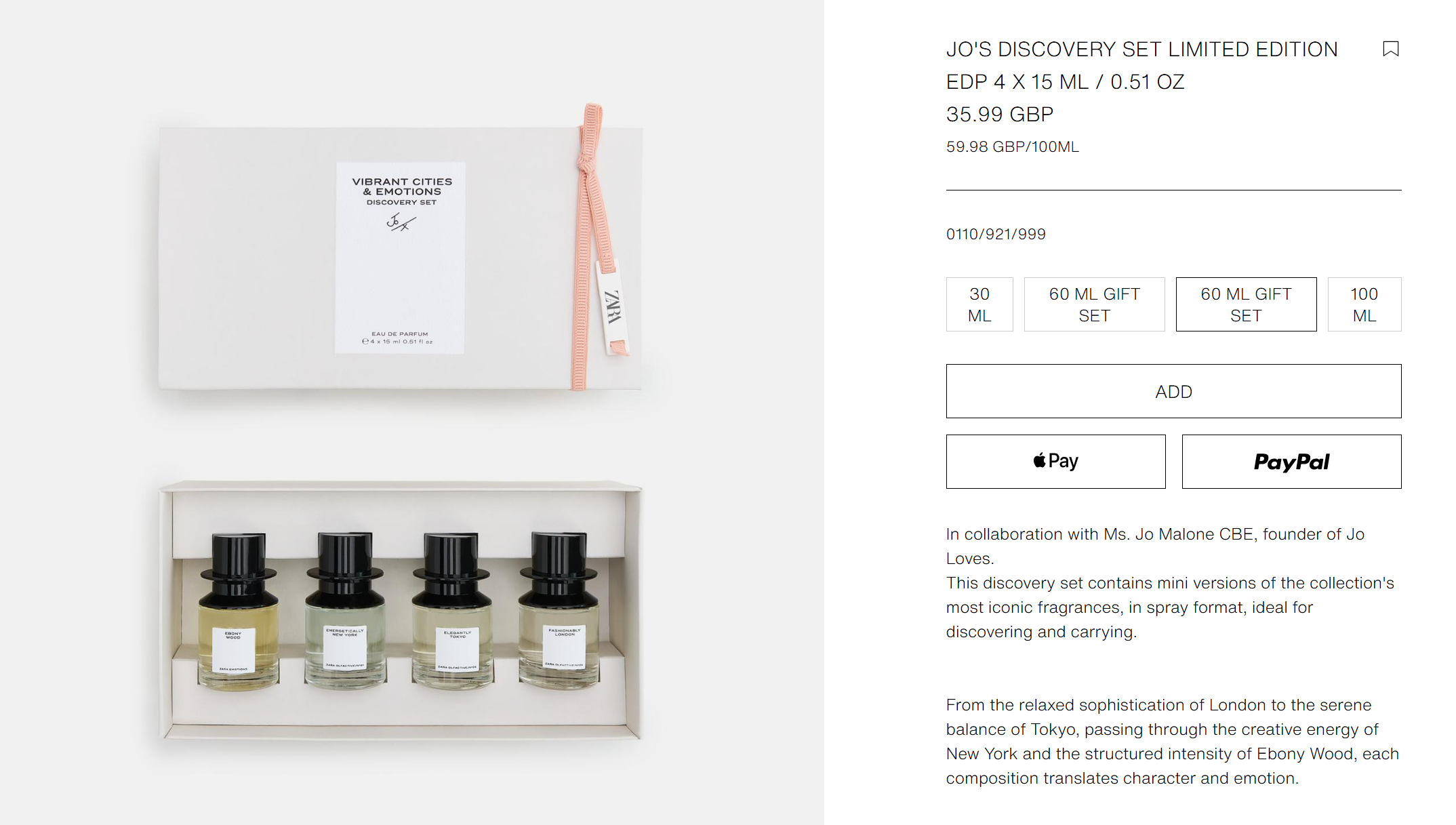
Zara’s website listing of the Vibrant Cities & Emotions Discovery Set: “In collaboration with Ms. Jo Malone CBE, founder of Jo Loves.” March 2026
The Jo Malone Sale: What She Gave Up in 1999
Jo Malone built her eponymous fragrance business into one of the most recognized scent brands in the world. In 1999, she sold it to Estée Lauder. She stayed on as creative director until 2006, at which point she left under a five-year non-compete clause.
When she sold the inventory, retail contracts, and commercial rights to her own name, she presumably agreed to contractual restrictions on how she could use it going forward, including in the marketing of fragrances. In return, she received compensation as part of the deal.
Once her non-compete expired in 2011, she launched Jo Loves, a new fragrance brand, strategically named to avoid the "Jo Malone" trademark now owned by Estée Lauder. In 2018, she was awarded the Commander of the Order of the British Empire (CBE) for her services to the British Economy and campaign. For over a decade, the two companies coexisted without legal conflict, until recently.
Malone has described the decision to sell her name as the "biggest mistake of my life." Because she sold her business and her name rights to Estée Lauder, this action may cause founders to question whether they can use their own name after selling their business, when they've used their own name as their brand and trademark.
Does a Creator Attribution on Packaging Count as Commercial Use?
This is the question the UK High Court will have to resolve, and it's not a simple one.
The Zara Emotions Collection by Jo Loves has been sold in Zara stores since 2019, and distributed across Europe, Mexico, Australia, and New Zealand. For years, that collaboration ran without triggering any legal action from Estée Lauder. What changed was the specific language that appeared on the newer packaging, accompanied by her signature.
Estée Lauder's position is that putting the name "Jo Malone" on a fragrance product, regardless of what follows it, crosses the line the 1999 agreement drew. Their statement framed it plainly: the contractual obligations were agreed to, compensation was paid, and those obligations "cannot be disregarded."
However, there is an arguable distinction between using a name as a brand (indicating commercial source) and using it descriptively (identifying who made something). For example, we can refer to Oscar-winning cinematographer Autumn Durald Arkapaw without infringing on the Academy of Motion Picture Arts and Sciences' “Oscar” mark. Whether a perfumer's name and CBE title on packaging constitutes source identification or nominative fair use will likely be central to the case.
"Passing Off" Explained: The Third Claim That Doesn't Require a Registered Mark
Trademark infringement requires a registered mark. Breach of contract requires a contract. But the third claim in Estée Lauder's lawsuit, “passing off,” is a common law tort that operates differently from both, and it's the claim most instructive for businesses that aren't dealing with registered IP.
The concept of “passing off” protects brand goodwill even when that goodwill isn't captured in a formal registration. Generally, to succeed on a passing off claim, a claimant must prove three things:
Goodwill: that they have an established reputation in the market the name or mark represents.
Misrepresentation: that the defendant made a representation (intentionally or not) that is likely to mislead consumers into believing their goods or services are connected to the claimant's.
Damage: that the misrepresentation causes, or is likely to cause, harm to that goodwill.
Intent is irrelevant. You don't have to be trying to deceive anyone. If the effect of your packaging, marketing, or branding creates confusion for ordinary consumers about who made what, passing off can apply.
In this case, Estée Lauder will likely argue that a customer who sees "Jo Malone CBE" on Zara packaging might reasonably associate those fragrances with Jo Malone London (the luxury brand) rather than understanding it as a creator attribution for a new collaboration.
The practical relevance for businesses: if your brand collaboration involves any person, name, or identifier that another company has invested in building goodwill around, you don't need a trademark registration to be in legal jeopardy. The common law can get there on its own.
Three Ways a Retail Collaborator Can Be Held Liable
Zara's inclusion in this lawsuit is worth examining as a clear example of the complications a retail entity might face, and how they can end up as a named defendant.
Under UK and US law, a downstream party that participates in distributing infringing goods can face liability through three routes:
Direct passing off: by distributing and selling goods with packaging that creates consumer confusion, even as a retailer rather than the original producer.
Contributory liability: by making a knowing and material contribution to the infringement. Estée Lauder will likely argue that Zara's decision to use packaging bearing the "Jo Malone CBE" attribution constitutes that contribution, regardless of whether Zara originated the language.
Vicarious liability: where a party exercises sufficient control over the infringing activity. The degree to which Zara approved, reviewed, or had input into the final packaging will be factually relevant here.
The due diligence checklist for any retail brand entering a creator collaboration should include a specific question: does this person have any prior contractual restrictions on the commercial use of their name, likeness, or identifier?
The Licensing Ramifications: What Collaboration Agreements Should Include
The structural lesson of this case runs deeper than Zara's specific situation. It goes to how collaboration and licensing agreements are drafted, particularly when a founder's name or personal identity is part of what's being licensed or sold.
The warranty of non-infringement. Any collaboration agreement should require the licensor, the party licensing their name, likeness, or brand, to expressly represent and warrant that no prior agreement restricts their ability to use those identifiers in the proposed context. This isn't a standard boilerplate provision. It requires specificity: the licensor should warrant that their use of their own name in this specific commercial context (product packaging, marketing materials, online listings) does not breach any prior contract, settlement, or consent agreement.
The indemnification clause. If that warranty turns out to be wrong, as Zara may now discover, the retailer or collaborating brand needs a clear contractual right to have the licensor cover its legal costs and any resulting damages. The indemnification must be broad enough to cover third-party IP claims arising from the licensor's representations, not just first-party disputes.
Permitted use carve-outs. For founders selling a business built on their name, the most important drafting fight is what gets carved out as a permitted use. The right to identify yourself as the founder of a venture, in a biography, a press release, or a collaboration credit is different from using your name as a brand. If that distinction isn't written into the agreement, the gray zone belongs to whoever has more money to litigate it.
IP attorneys advising clients on business sales should be pressing for explicit carve-outs that protect the founder's ability to identify themselves professionally, including in commercial contexts, provided the use doesn't create brand-to-brand confusion with the sold entity. A clause that says "Seller shall not use the name [X] in connection with fragrances" leaves enormous interpretive room. A clause that enumerates permitted uses, including attribution as a creator or founder in collaboration contexts, does not.
The Bigger Pattern: Founders Who Sold Their Names
Jo Malone isn't the only one who has been here. The fashion and beauty sectors have produced several variations of the same story.
Bobbi Brown sold her namesake makeup brand to Estée Lauder in 1995. After testing the waters in health supplements under the brand Evolution_18, her non-compete period ended in 2020 and she launched Jones Road Beauty. Her full name still doesn't appear prominently in Jones Road's commercial marketing, which likely reflects how those rights were originally structured.
Kate Spade relinquished the commercial rights to her name when she sold her brand to Liz Claiborne in 2006. She went on to launch a new brand under the name Kate Valentine. Designer Elizabeth Emanuel, who co-designed Princess Diana's wedding dress, lost the rights to her own name after selling her business, though she eventually regained them years later.
The pattern reveals a feature, not a flaw, of how brand acquisitions in this sector work. When a company pays a premium for a brand built on a founder's identity, the goodwill it's purchasing is the public's association of that person with that brand. Restricting the founder's ongoing use of their own name is how the acquirer protects that investment. Founders who don't fully grasp that dynamic at the time of sale, or who trust that future common sense will prevail over contractual language, tend to discover the stakes only when they try to work freely again.
What to Negotiate Before You Sign
If you are a founder considering selling a business that carries your name, or a brand entering a collaboration with a named creator, the Jo Malone case is worth treating as a checklist rather than just a news story.
Before you sell:
Define "commercial use" explicitly. Don't assume the term is self-evident. Specify whether a creator attribution on a third-party product counts, and negotiate a carve-out if you want that right preserved.
Ask for a list of permitted future uses in writing. These should cover identifying yourself as a founder, using your name in biographical contexts, and crediting yourself as a creator in collaborations, if those are activities you expect to pursue.
Understand that compensation for restricting your name rights is part of the deal price. If that restriction is broader than you realize, you may be undervaluing what you're giving up.
Before you collaborate:
Conduct upstream IP due diligence on any person whose name will appear on packaging or marketing materials. A prior sale of business or brand settlement may restrict uses you haven't considered.
Require a warranty of non-infringement from your collaborating partner, specific to the planned use of their name and identity.
Ensure indemnification runs directly from the licensor to you for any third-party IP claims arising from their representations about what they're permitted to do.
The UK High Court's eventual ruling in this case should help clarify where the line sits between a trademark use and a creator attribution, a nominative fair use in this context, at least under English law. Until then, the safest position is to treat any agreement involving a founder's name as carrying more complexity than the language on the page suggests.
This article is for informational purposes only and does not constitute legal advice. If you are reviewing a brand acquisition, business sale, or collaboration agreement involving trademark or name rights, Martell Media House PLLC works with founders and IP licensees facing these issues.